
Daniel Sánchez Calles
Head of Engineering
Does BIM methodology have limits? When is a BIM implementation finished? Is my company fully digitalised?
These are the questions we usually come across (and ask ourselves) throughout our projects. No, BIM has no limits. No, your company can be in constant digital development, but is that healthy for your organisation?
Something fundamental when digitalising a company is knowing where to draw red lines. Otherwise, you will fall into a vicious circle of constant standardisation and regular process changes that will end up having the exact opposite effect to the one intended. The hard part is knowing where to draw those red lines, because if you do not define the standards, you will never know whether they work.

Digitalising: how do you go about it?
That is the big question. There is no exact formula: every client, every project and every person has their own pace, needs and capabilities, so you need to carry out a preliminary study, understand the product well and plan according to what you need. In short, draw up a BIM/Digital Implementation Plan.
As a starting point, do not try to go from 0 to 100. Step by step: digitalisation is not a process where you should expect benefits early on, and patience will be your best ally. In our experience, the digitalisation of a medium-sized company starts to bear fruit after three years on average.

Another key aspect is deciding which needs to cover, rather than getting carried away doing everything you see or are told about. It is very common to start out wanting to standardise processes for the entire asset life cycle, for every dimension of BIM… a mistake! Build a tailored model that is as open to collaboration as possible, but that does not cover unnecessary needs.
An interesting strategy is to set red lines at key processes, with a trial period after each one, test how well they work and bed the processes in before moving on to the next ones. The big problem we will face is that these processes end up intertwined with earlier and later processes as the company's digital maturity grows.
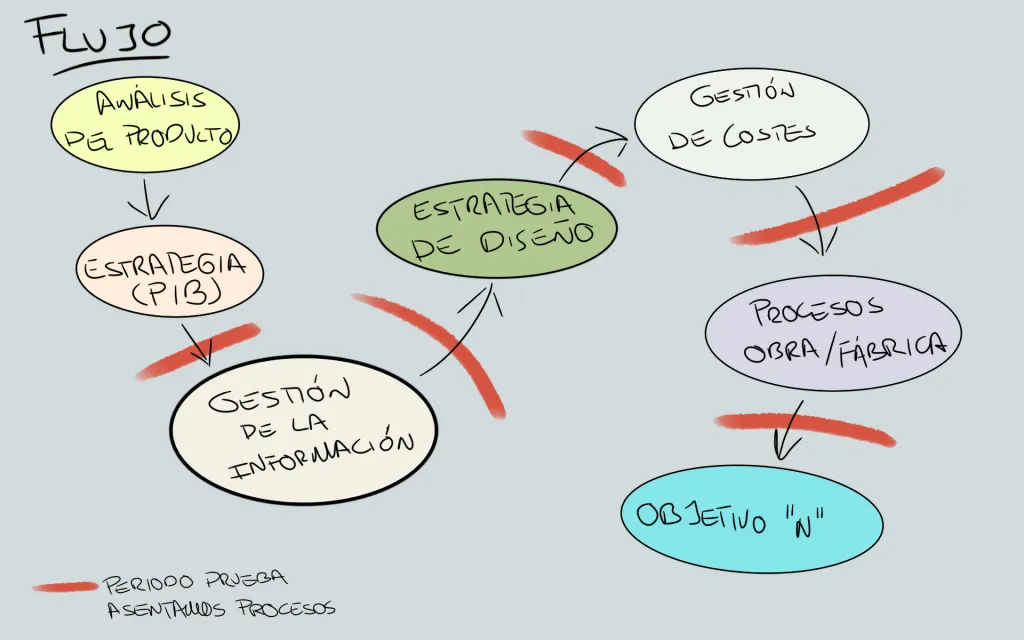
At last, a standardised process!
After standardisation and roll-out, ideally you should set review periods, but they should not become a daily routine: if that happens, you will never have a standard and you will be stuck in endless digitalisation.
That is why it is essential to know what we really need. Otherwise we will be in constant development, but it will never be truly productive because the process keeps changing.